This month, Andreessen Horowitz published a piece telling companies they need a new kind of CFO. The argument is simple. AI has removed the data bottleneck, so the most valuable person in finance is no longer the one crunching the numbers by hand. It is the one who designs the system that produces those numbers on its own.
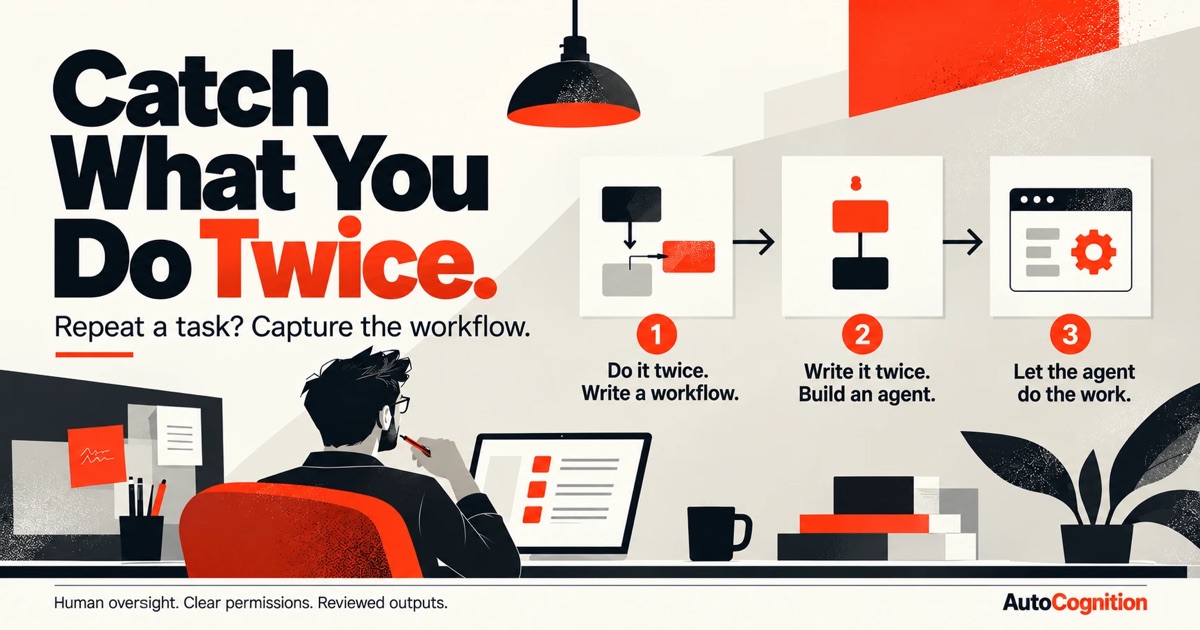
If you are a business owner or operator rather than a CFO, the same logic lands on you. If you still do the same manual task two or three times a week, that piece is about your work.
Thinking about this, I was reminded of a book I often recommend, Simple Numbers, Straight Talk, Big Profits by Greg Crabtree and Beverly Herzog. They write about the jump from around $1M to $5M in revenue, where a business has to move from the owner doing everything to a defined structure with people in formal roles. Finance is one of those roles.
AI makes that jump less risky to attempt. It does not make the specialist roles obsolete. Far from it. People are still the ones who carry accountability and judgment. The recent wave of fractional C-suite hires already gives smaller businesses a way to scale into that structure, and the role is about to evolve again as AI engineering skills become part of the job.
The payoff was never the model
A smarter model on its own changes little. The value shows up when you build a repeatable system around it, and most companies have not done that yet. BCG's 2026 Applied AI Index found almost half of companies now generate value from AI, while only 5 percent have enterprise-wide controls for agents that act on their own. Plenty of usage, little operational structure.
The gap between a clever model and money saved is the structure around it. Access to capability is no longer the hard part. Most owners already have a strong model on a $30 monthly plan. Turning that into work that happens reliably without you is the piece still missing.
The repeatable work has crossed the line
The routine, checkable tasks that fill a typical small business week are now handled well by current AI models, often better than a junior human. Mercor ran a month-end close benchmark against junior accountants. Claude Opus 5 completed the tasks correctly 100 percent of the time, against a human baseline near 37 percent. Month-end work is structured, repeatable document work, the same shape as much of the admin that brokers, agencies and professional services firms do.
a16z reports the leanest finance teams now aim for finance at 2 percent of headcount, down from a historical 5 percent. Anthropic's own finance team maintains more than 70 AI skills it reuses.
The work most owners assume needs a person, reconciling documents, checking figures, drafting the standard notes, summarising records, is work AI now handles to a checkable standard. The question is no longer whether it can. It is whether you have set up a workflow to run it.
The cost reason to wait is gone
Compute prices were a fair reason to hold off on high-volume automation last year. That reason closed this month. Claude Haiku 5.5 landed at $0.10 per million input tokens and $0.50 per million output tokens, so running tasks under 100k tokens is up to 75 percent cheaper than the previous Haiku for the same work, and it runs on AWS and Azure.
High-volume document triage, the kind of job you run hundreds of times a week, now costs cents. The sum that used to make automation a close call does not anymore. What is left to decide is which job, not whether the economics work.
The new job title is an old job with a new name
a16z calls this person a finance engineer and calls the workflows agents. Strip away the 2026 terminology and it describes a discipline businesses have run for decades. Document how the work is done, then hand the repeatable parts to a system that does them the same way every time.
This is process documentation and automation, the discipline good operators have always built with checklists and templates.
What has really changed is that writing the steps down in plain English is now most of the build. You describe the steps clearly and the agent runs them, with testing of course. Where before you needed a developer to do everything, now you get them to harden only the parts that need it.
You do not need a technical degree or a data team. You need the habit of catching the work you repeat and writing it down clearly enough to hand off. The owners pulling ahead are the ones building that habit.
Who stays accountable when the agent runs
This is where the human comes back in, and it ties straight to the fractional C-suite point from the top. Automating a workflow does not remove the need for a senior person. It changes what that person does. Someone has to decide what each agent is allowed to touch, confirm it did the job properly, and carry the accountability when it gets something wrong. That is governance. It is not a compliance formality. It is deciding in advance what the system can run on its own and what still needs a person to sign off.
This is the evolution those fractional roles are going through. The finance or operations lead who used to own the numbers now owns the system that produces them and the controls around it. Call it a finance engineer if you like. The job is judgment paired with the skill to design and govern the workflow. BCG's 5 percent figure from earlier, the share of companies with enterprise-wide controls for agents that act on their own, is a governance gap. Most are running the models with almost no one owning what they are allowed to do. The businesses that get this right put a named person on it before they scale the automation, not after.
What to do about it
You do not need a complex AI strategy. You need to find the first job you do twice and write it down.
- Track the repeats. For one week, note every task you or your team do more than once. Standard emails, weekly summaries, the same checks on every file.
- Pick the candidate. Choose one that is repeatable and quick for a person to check. That is your first workflow.
- Document the process. Write out every step in plain English, the way you would hand it to a new team member. This is the core work, and it is the part most teams skip.
- Run and review. Use a cheap model for the bulk and a stronger model or a person for review. Keep human sign-off until the output earns your trust.
- Automate fully. Only after a workflow runs twice without errors should you turn it into an agent that runs unprompted.
Find the first job worth writing down. If you want help finding the first job in your business worth writing down, email me at pete@autocognition.com.au.
Not sure which job to write down first?
Get your free AI Assessment. We'll map where your time is actually going, which repeat task is worth automating first, and what it would save you each week.